

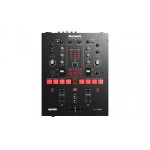
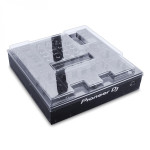







When Pioneer DJ introduced the DJM-S9 in 2015, it entered a battle-mixer market that already had strong competition and a deep history.
Rane had already established itself as one of the biggest names in scratch and performance mixers. Turntablists had been pushing equipment to its limits for years. Serato had already changed how DJs used turntables with digital music.
But the DJM-S9 arrived at exactly the right moment.
It combined battle-DJ performance, Serato integration, performance pads, customizable faders, effects, and dual-computer connectivity in a layout that immediately made sense to scratch DJs, hip-hop DJs, and open-format performers.
The S9 didn’t invent the battle mixer.
But it helped redefine what DJs expected a modern 2-channel performance mixer to be.
And for a period of time, it seemed like every serious scratch DJ wanted one.
The Battle Mixer Market Before the S9
Before the DJM-S9 arrived, battle mixers were already highly developed.
Rane had built a strong reputation through mixers such as the TTM series and the Sixty-Two. These mixers were trusted by professional DJs, scratch DJs, and turntablists around the world.
Serato integration was already becoming an important part of professional DJ setups.
DVS allowed DJs to keep the physical feel of turntables while accessing digital music libraries.
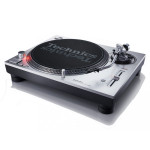
Scratch DJs could use Technics SL-1200s, control vinyl, and software while still performing with the techniques they had spent years developing on traditional records.
The foundation was already there.
What Pioneer DJ did with the S9 was bring several of those ideas together in a way that felt extremely performance-focused.
Pioneer DJ Entered the Battle Mixer Conversation
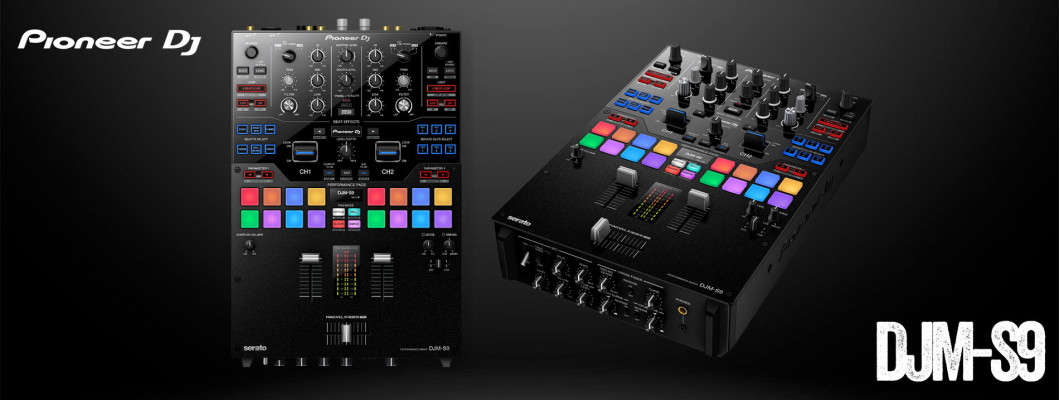
The DJM-S9 was introduced as a 2-channel Serato DJ battle mixer.
Pioneer developed the mixer with competition-style DJs in mind, asking what a mixer needed to provide for someone performing at the highest level of turntablism.
That mindset showed immediately in the layout.
This wasn’t simply a two-channel club mixer with Serato added to it.
The entire mixer was designed around performance.
Large pads.
Fast access to effects.
A highly adjustable crossfader.
Dual USB connections.
DVS control.
Everything was positioned so a DJ could manipulate music quickly without constantly reaching for the laptop.
That was one of the S9’s biggest strengths.
The laptop held the music.
The mixer became the instrument.
The Performance Pads Changed the Workflow
One of the most recognizable features of the DJM-S9 was its 16 multicolor Performance Pads, with eight pads available for each deck.
These gave DJs immediate access to functions such as:
Hot Cues.
Rolls.
Slicer.
Loops.
Instead of using a separate MIDI controller or constantly reaching toward the laptop, DJs could trigger performance functions directly from the mixer.
That mattered.
For scratch DJs, speed is important.
You don’t want to stop a routine to search for something on a computer screen.
You want the controls directly underneath your hands.
The S9 helped make performance pads feel like an expected feature on professional battle mixers.
Today, seeing eight pads underneath each channel on a scratch mixer feels normal.
In 2015, the S9 helped make that layout feel essential.
The MAGVEL FADER PRO Became a Major Selling Point
For scratch DJs, the crossfader might be the most important part of the entire mixer.
Pioneer introduced the MAGVEL FADER PRO with the S9 and gave DJs significant control over how it behaved.
DJs could adjust the fader’s feel.
They could change the curve.
They could adjust the cut-in.
The fader bumpers could also be changed to create different levels of resistance.
That customization mattered because scratch DJs develop extremely specific preferences.
Some want a loose fader.
Some want more resistance.
Some want an extremely sharp cut.
Others want slightly more travel.
The S9 allowed DJs to customize the mixer around their technique instead of forcing every DJ into the same feel.
That became one of the mixer’s biggest attractions.
The FX Paddles Were Made for Performance
The DJM-S9 also featured large FX paddles that became one of the most recognizable parts of the mixer.
Instead of turning an effect on with a small button, DJs could quickly push or pull the paddle during a transition or scratch routine.
It felt physical.
It felt immediate.
And it became another part of the performance.
You could hit an Echo.
Trigger an effect during a scratch.
Use the paddle momentarily.
Or lock it into place.
That layout made effects feel less like menu options and more like something DJs could actually play.
Later battle mixers would continue expanding this idea.
Dual USB Made DJ Changeovers Easier
Another major feature was the inclusion of dual USB soundcards.
Two DJs could have their laptops connected at the same time.
That made transitions between DJs much easier.
Instead of one DJ finishing their set, unplugging everything, and then having the next DJ connect their computer, both systems could remain connected.
For clubs, events, battles, and back-to-back sets, this was a major workflow improvement.
It also helped move the S9 beyond being only a battle mixer.
This was a feature working DJs could appreciate every weekend.
Why It Felt Like Every DJ Needed One
Obviously, not every DJ actually needed a DJM-S9.
A DJ playing long house sets on four players had completely different requirements.
But within scratch, hip-hop, battle, and open-format circles, the S9 quickly became one of the most desirable mixers available.
Part of that came from the features.
Part came from Pioneer DJ’s reputation.
And part came from who was using it.
Pioneer placed the S9 in front of serious turntablists and battle DJs.
When DJs saw high-level performers scratching, juggling, and performing routines with the S9 sitting between two turntables, the mixer gained credibility quickly.
It wasn’t simply being advertised as a battle mixer.
Battle DJs were actually using it like one.
And once DJs started seeing it consistently in videos, competitions, clubs, and professional setups, the S9 became aspirational.
You wanted two Technics.
You wanted Serato.
And sitting between them, you wanted an S9.
It Became More Than a Battle Mixer
One of the biggest reasons the DJM-S9 became so influential was that its usefulness extended far beyond DJ competitions.
Open-format DJs loved it.
Hip-hop DJs loved it.
Club DJs using turntables loved it.
Mobile DJs using DVS could benefit from it.
The performance pads were useful whether you scratched or not.
The FX paddles were useful in regular club transitions.
Dual USB was useful during DJ changeovers.
The crossfader was useful for quick cuts and open-format mixing.
The S9 took features associated with battle DJing and made them useful to a much wider group of DJs.
In many ways, it helped battle-mixer technology become mainstream.
The Mixer Became an Instrument
This may be the most important part of the DJM-S9 story.
Older mixers were often viewed primarily as the center point between two turntables.
Audio came into the mixer.
You blended the channels.
You adjusted EQ.
You used the crossfader.
The S9 expanded that idea.
Now the mixer itself contained performance tools.
Pads.
Effects.
Software controls.
Advanced fader adjustments.
DVS integration.
The mixer wasn't simply managing the audio anymore.
The DJ could actively perform with it.
That idea would become increasingly important in the mixers that followed.
The S9 Raised Expectations
After the DJM-S9 became successful, the expectations around professional 2-channel mixers continued rising.
A battle mixer could no longer get by with simply having two channels and a good crossfader.
DJs increasingly expected:
Performance pads.
Advanced effects.
Serato integration.
Dual USB.
Customizable faders.
Professional sound quality.
Flexible routing.
DVS support.
Software controls.
The category was becoming more competitive.
And every major manufacturer had to respond to what DJs now expected from a premium scratch mixer.
Rane Continued Pushing the Category
It’s important to give Rane credit.
The company had already been building respected battle mixers long before the S9 appeared.
After the S9 era began, Rane continued pushing the category with mixers such as the Seventy-Two.
The Seventy-Two brought features such as a touchscreen, performance pads, advanced effects, and updated fader technology.
The battle-mixer market had entered an arms race.
Manufacturers weren’t simply competing on sound quality or crossfader performance anymore.
They were competing on complete workflow.
Screens.
Pads.
Effects.
Software integration.
Connectivity.
Customization.
The S9 was one of the products that helped accelerate that shift.
Five Years Later Came the DJM-S11
In 2020, Pioneer DJ introduced the DJM-S11.
The connection between the two mixers was obvious.
The S11 took the foundation established by the S9 and pushed it forward.
It added a 4.3-inch touchscreen.
The Performance Pads became larger.
The MAGVEL FADER PRO was improved.
More effects were added.
New functions such as Scratch Bank and Touch FX expanded what could be controlled directly from the mixer.
The S11 also introduced deeper software integration and more advanced routing options.
But what is interesting is that Pioneer didn’t completely rethink the mixer.
Instead, it evolved the S9 philosophy.
That says a lot about how successful the original concept had been.
Then Came the DJM-S7
The DJM-S7, introduced in 2021, provided another version of the modern Pioneer battle-mixer workflow.
Again, DJs saw familiar elements.
Two channels.
Performance pads.
Effects.
Serato DJ Pro integration.
rekordbox support.
Modern connectivity.
A battle-style layout.
The S7 didn’t replace the S9 in exactly the same way the S11 did.
But it continued the design language and workflow that the S9 helped popularize.
The family resemblance was obvious.
The S9 Helped Create a New Mixer Blueprint
This is really where the DJM-S9’s influence can be seen.
Modern 2-channel performance mixers often follow a similar general philosophy.
Large performance pads near the bottom.
Quick effects access.
Highly customizable crossfaders.
Deep DVS integration.
Dual-computer connectivity.
Advanced software control.
Compact battle-style layouts.
Manufacturers may implement those ideas differently, and many of those concepts existed before the S9.
But the S9 packaged them together in a way that became extremely influential.
It helped create a blueprint.
It Also Changed Open-Format DJing
The S9’s influence wasn’t limited to turntablism.
Open-format DJs benefited heavily from the same features.
Think about what an open-format DJ might need during one set.
Hip-hop.
R&B.
House.
Latin.
Pop.
Rock.
Throwbacks.
Quick transitions.
Cue points.
Loops.
Effects.
Scratch techniques.
Fast BPM changes.
A mixer like the S9 allowed all of those performance styles to exist in one workflow.
That helped make the S9 particularly popular with working DJs who needed versatility.
You didn't have to be performing a DMC routine to appreciate what the mixer could do.
The Rise of Performance DJing
The S9 also arrived during a time when the line between traditional mixing and performance DJing was becoming increasingly blurred.
DJs were no longer simply blending one song into another.
They were using:
Hot Cues.
Loops.
Samples.
FX.
Scratch routines.
Tone Play.
Cue juggling.
Live edits.
DVS.
The mixer needed to keep up.
The S9 fit perfectly into that moment.
It allowed turntable DJs to keep the physical workflow they loved while gaining many of the performance features controller DJs were beginning to use.
That combination was powerful.
The Used Market Shows the Legacy
One of the easiest ways to understand the impact of old DJ equipment is to look at whether people still want it after newer models arrive.
The DJM-S9 continues to have a following.
Some DJs prefer the straightforward layout.
Some don’t need a touchscreen.
Some developed years of muscle memory around the mixer.
Others simply associate it with an important era of Serato and turntable performance.
Newer mixers are more advanced.
But more advanced does not automatically mean every DJ wants to move on.
Sometimes familiarity matters.
Sometimes simplicity matters.
And sometimes a product becomes good enough that DJs continue using it long after the replacement arrives.
The S9 Didn’t Invent Everything
This is important to say.
The DJM-S9 did not invent the scratch mixer.
It did not invent DVS.
It did not invent software-integrated DJing.
It did not invent the adjustable crossfader.
And Pioneer DJ was not the only company pushing the battle-mixer category forward.
Rane and other manufacturers played enormous roles in developing the technology and culture that existed before and after the S9.
That history matters.
The DJM-S9’s importance comes from how effectively it brought multiple ideas together at the right moment.
It Arrived at the Perfect Time
By 2015, several trends were coming together.
Serato was deeply established.
Turntablism remained influential.
Controllers had made performance pads normal.
DJs were increasingly using cue points and loops creatively.
Open-format DJs wanted faster workflows.
Turntable DJs wanted modern software integration without giving up their decks.
The S9 sat directly in the middle of those trends.
That timing helped it become more than another product release.
It became part of a generation of DJ setups.
Newer Mixers Owe Something to That Era
Look at today's professional 2-channel performance mixers.
Touchscreens.
Large pads.
Multiple effects engines.
Advanced faders.
DVS.
Software integration.
USB hubs.
Dual-computer workflows.
Deep customization.
The technology has moved forward considerably.
But the underlying idea remains familiar:
A battle mixer should be much more than something that combines two audio channels.
It should be a performance center.
That philosophy is now normal.
The DJM-S9 helped make it normal.
Final Thought
The Pioneer DJM-S9 didn't become important simply because it had a Pioneer logo on it.
It arrived at the right moment and gave DJs a workflow that matched where DJing was heading.
Scratch DJs got a professional battle mixer.
Serato DJs got deep software integration.
Open-format DJs got fast access to pads and effects.
Working DJs got dual USB connections.
Turntablists got a crossfader they could customize around their technique.
And the entire industry got another example of just how powerful a 2-channel mixer could become.
The S11 is more advanced.
The S7 came later with its own features.
Rane and other manufacturers have continued pushing battle mixers forward.
Technology keeps moving.
But the S9 holds an important place in the story.
Because the DJM-S9 didn't remain the newest mixer forever.
It did something more important.
It became one of the mixers every new professional battle mixer had to compete against.
Leave a Comment